Again and Again and Again How Glutamate Spillover Shapes Our Obsessions
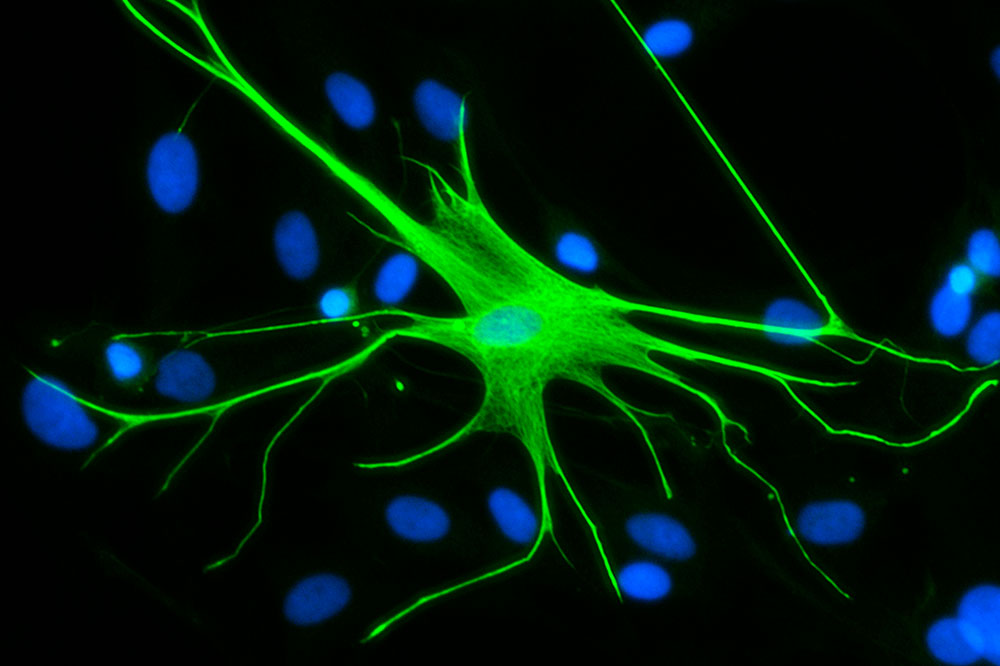
Human being astrocytes are important for brain signaling. Researchers are gaining new insights into their function by studying their worm equivalent.
Repetition can exist useful if yous're trying to memorize a poem, master a guitar riff, or only cultivate practiced habits. When this kind of beliefs becomes compulsive, notwithstanding, it can become in the style of normal life—an impediment sometimes observed in psychiatric illnesses like Tourette's syndrome and autism spectrum disorders. Now, Rockefeller scientists have identified a brain excursion that underlies repetition in worms, a finding that may ultimately shed light on similar behavior in humans.
Studying the microscopic roundworm C. elegans, the researchers establish that defects in one protein cause animals to reorient themselves over and once again. Described in Nature Communications , these observations are bolstered by previous enquiry in mice, and advise that similar mechanisms may drive repetitive behavior in a range of animals, including humans.
Chemical cleanup
The scientists initially ready out to empathize how astrocytes, star-shaped cells institute in mammalian brains, assist neurons practice their job. Astrocytes are idea to be responsible for, among other things, disposing of excess neurochemicals at synapses, the connections between neurons. This task is vital because if chemicals are not removed in a timely mode, they can stimulate neurons in unexpected ways, disrupting normal brain function. To better understand this procedure, Menachem Katz, a research associate in the lab of Shai Shaham, looked to C. elegans CEPsh glial cells, which he suspected to be the worm equivalents of astrocytes.
Confirming this suspicion, Katz, Shaham, and their colleagues, used mRNA sequencing to show that mouse astrocytes and CEPsh glia accept similar genetic signatures. Among other commonalities, both cell types produce the protein GLT-1, the mammalian version of which is responsible for immigration the chemical glutamate abroad from synapses. This finding, says Shaham, afforded the researchers a unique opportunity to define how astrocytes and GLT-1 work.
"Scientists accept been trying to sympathize the functions of astrocytes for many years, and in mammals it's not easy because these cells are essential for keeping neurons alive," he says. "But in C. elegans in that location are only four CEPsh glial cells, and they are not required for neuron survival. This allowed us to investigate the specific roles of glutamate transporters, without worrying about the side effects of neuron sickness."
To practise so, the researchers created C. elegans lacking GLT-one. Surprisingly, this depletion did non result in glutamate accumulation at synapses, as was expected. Instead, the worms exhibited oscillations in synaptic glutamate levels—and a peculiar behavioral defect.
"These animals inverse their management at a crazy rate. They just kept moving frontwards and going back, moving forward and going back," says Shaham, the Richard E. Salomon Family Professor. "And when we analyzed this behavior, we discovered that they did and so in a actually interesting design."
Turn, plough, turn
It'southward perfectly normal for C. elegans to change course every now and then. Typically, the worm reorients itself about once every 90 seconds. Simply worms defective GLT-one, the researchers constitute, took this action to the extreme: at xc second intervals the animals executed not i reversal, but bursts of them. "It's as if once they start the action, they can't stop repeating it," says Katz.
Further experiments revealed that removal of the glutamate receptor MGL-2 blocked both repetitive reversals and synaptic glutamate oscillations. The researchers concluded that when glutamate is not efficiently cleared, the chemical stimulates MGL-2, which in turn triggers the release of yet more glutamate. This process then repeats on a loop; and every time glutamate is released, it activates the neuron responsible for initiating reversals.
"These findings suggest a unproblematic model for how repetition tin can occur in worms," says Katz. "And, it turns out, this model may agree up in more complex nervous systems."
Indeed, past experiments have shown that GLT-1 mutations cause repetitive grooming in mice, and that compounds blocking the mouse version of MGL-2 eliminate similar beliefs in other contexts. Taken together with the new findings in C. elegans, this enquiry suggests that abnormal glutamate secretion may underlie repetitive behaviors across the animal kingdom—raising the possibility that they may be relevant to understanding pathological repetition in humans.
Consistent with this idea, human genetics studies have found mutations associated with glutamate signaling in patients with obsessive compulsive disorder and autism spectrum disorders, both of which tin be accompanied past repetitive behavior.
"We were actually excited to encounter these links in the scientific literature because information technology means our findings may help uncover a plausible machinery underlying an important class of human diseases," says Shaham. "And, more broadly, we're showing that candidate genes affected in human disease tin be studied and verified in the simpler worm."
Source: https://www.rockefeller.edu/news/25817-research-repetitive-worm-behavior-may-implications-understanding-human-disease/

Postar um comentário for "Again and Again and Again How Glutamate Spillover Shapes Our Obsessions"